

ACT / SRO / Community Policing
Norton Police Department
Problem Oriented Policing Anti-Crime Team
(POP ACT)
2025
This reporting period covers January 1, 2025 thru December 31, 2025.
Overview
Since May of 2015, the police department has had a Problem Oriented Policing Anti-Crime Team. This team came under the direction of the Detective Division. The team targets various types of repeated calls for service in order to come up with non-traditional solutions for these quality-of-life incidents and provide necessary resources to those in need. The team relentlessly conducts proactive follow ups on many areas of community concern. The team has expanded to several officers being assigned on a part time rotating basis. This allows for more knowledge of community issues and better communicative response. The Anti-Crime Team primarily serves as a support unit to the Patrol Division and Detective Division, and works with the School Resource Officer when needed. The Anti-Crime Team is an added resource for those units in need of additional manpower. Patrol Officer Christopher McCarthy has taken on the responsibility of being the team leader. The team also included Patrol Officer Bradford Wry, Keith Kennedy and Ashley Cibotti.
The Anti-Crime Team also works with outside agencies such as neighboring POP teams, probation, parole and others. The Team not only works closely with Law Enforcement agencies but also communicates and collaborates with the community and neighborhood groups. The Anti-Crime Team is an added resource for both the department and the community at large.
Problem-oriented policing (POP) was coined by University of Wisconsin–Madison professor Herman Goldstein. POP is a policing strategy that involves the identification and analysis of specific crime and disorder problems within the community. After these problems are identified, officers can develop effective and nontraditional response strategies.
1. Norton Police Co-Responder Model
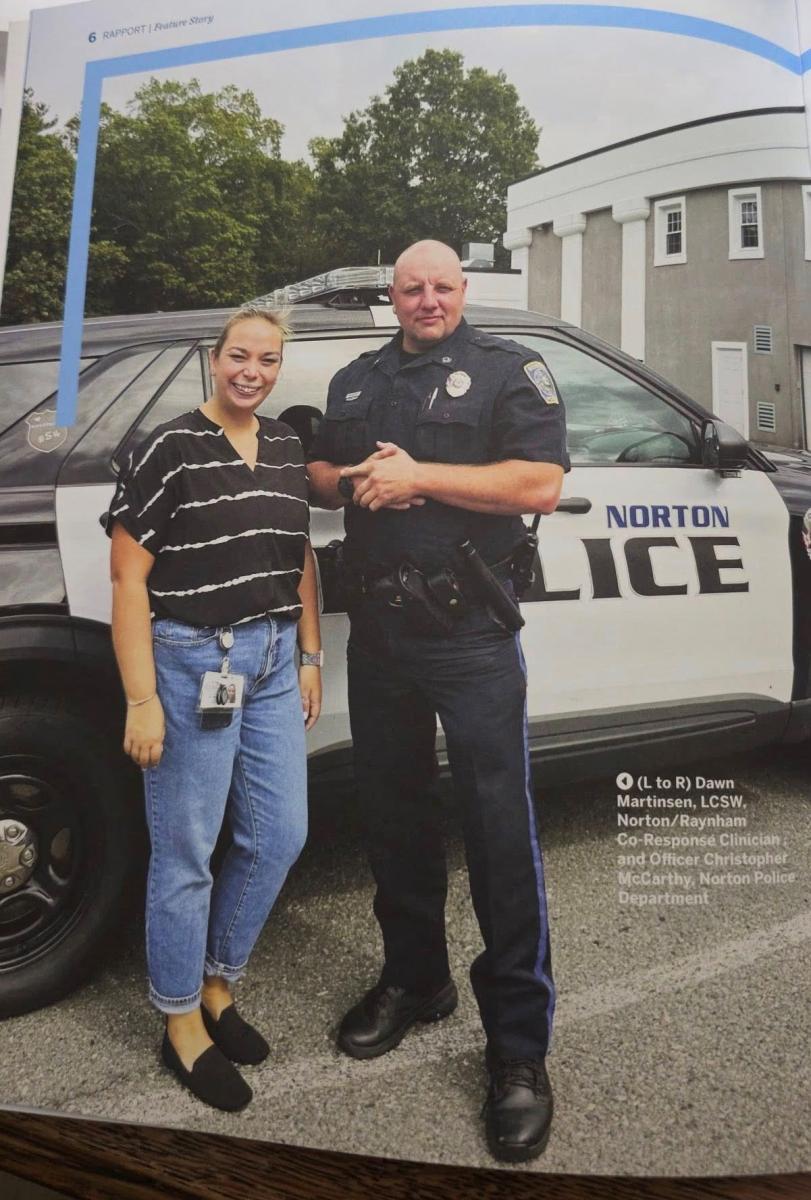
Pictured are Clinician Dawn and Ptlm. McCarthy.
Credit: WIlliam James College Report. Fall 2025/Winter 2026 pg 6 annual report edition
In 2017, in an effort to provide more services and resources to the residents of Norton, the Norton Police Department partnered with the Community Counseling of Bristol County (CCBC), as they recently acquired the state contract and have a crisis center in Norton.
Since March 10, 2021 we began a formal co-responder jail diversion program. In 2022 we signed on to a Department of Public Health grant with the Raynham Police Department and received funding. The grant allows for three (3) part time mental health licensed clinician to work riding along to calls, as well as more availability to services and resources.
The team has continued to make home visits with a representative of CCBC to individuals suffering with mental health issues and/or substance abuse dependency. We do train officers on Community Crisis Intervention and provide updates on various Massachusetts laws which allows for officers to implement an emergency restraint and hospitalization of persons posing risk of serious harm by reason of mental illness, dealing with individuals with trauma and post-traumatic stress as well as officer wellness.
Co-Responder case sample and services
Since this program started, there have been roughly 1,272 follow ups or live 911 calls that the clinician has responded to. There have been roughly one hundred and eleven (111) Sections 12s completed, and eighteen (18) arrests made. This provides resources as well as serves as a hospital and jail diversion program. A Section 12 allows for the emergency, involuntary, short-term (up to 3-day) restraint and hospitalization of individuals with mental illness who pose a serious risk of harm to themselves or others. It enables evaluation and treatment without consent to ensure safety.
2025 CASES HIGHLIGHTS
In 2025, there were 251 follow-ups with nineteen (19) section 12’s and one (1) related arrest. The collaboration, communication, and increased knowledge have successfully diverted people from emergency hospital visits and the criminal justice system.
ELDER ABUSE CASE
The problem-oriented police (POP) team received numerous tips both anonymous as well as first hand accounts from residents and staff at an apartment complex in town of possible elder, financial, and physical abuse. Both Patrol and the POP team responded several times to speak to the victims identified as victim 1, 70-year-old female who is physically disabled and victim 2, a 70-year- old female who is developmentally disabled. The suspect was identified as a roommate of the two and caregiver for both. He is a 69-years-old male and has been living with them for fifteen years. He was both hostile, aggressive and would not cooperate with the police. Due to the nature of the allegations, we attempted to investigate. However, we were met with extreme hostility from the male and had not gained the trust of the females. Both females were essentially recluses in the complex due to living in fear of repercussions. They did not go out of the apartment unless absolutely necessary nor did they attend any functions or conversate with other residents.
We continued to follow up weekly with the females gaining a strong rapport and trust with both of them. Ultimately, they did in fact state that the male had physically, financially and mentally abused them for quite a while. Criminal charges were pursued through the Attleboro District Court House and the male was trespassed from the facility. Now both females are thriving within their community, attending social events and enjoying coffee in the common area. We continue to follow up with them and couldn’t be happier with their progress and new found freedom.
JUVENILE MENTAL HEALTH CASE
Norton Patrol along with the POP team received numerous calls for service in regards to a residence in town, due to mental health related concerns. There were also concerns voiced for a student who has been displaying erratic and nonsensical behavior. The adult family members also both have an extensive history of mental health related / substance abuse concerns. Numerous section 12’s (involuntary committals) have been completed for all parties who reside at the residence. Due to the juvenile being an extremely gifted student, the school staff became extremely concerned because of the increase in erratic behavior that the student was exhibiting. The POP team was able to meet with the school’s psychologist, counselors, and school resource officer (SRO) and had a meeting with the student. We were able to gain a strong connection with the student and would meet with the student to come up with a plan to remove him from the tumultuous environment he has been subjected to. The POP team was able to speak with his biological family member who lives at a separate residence in Town. They have a strained relationship from each other and there was very little communication between the two. The family member agreed to move the student in with them to help alleviate the hostile and traumatic environment he has been subjected to. Since the move we are happy to report that the student is doing well. He is no longer showing up to school disheveled, or acting out. He is attending his classes, participating in school functions as well as sports and has a positive outlook on life. We will continue to follow up and offer any and all resources to ensure he excels moving forward.
2.Substance Abuse/Opiate Addiction Overview
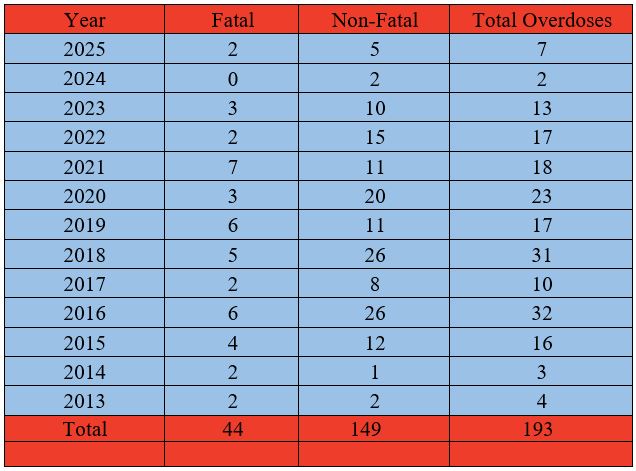
We have continued to see a decrease over the past few years in overdose related calls for service. The POP team is continuing to address the opiate addiction. Opiate addiction not only has an impact on crime, but also is often fatal. Since the inception of the Problem Oriented Policing Anti-Crime Team, officers have collaborated with numerous treatment facilities helping those addicted to opiates get treatment. This has been very well received by the community and those in need of assistance. The police department recognizes that we will not arrest our way out of this problem.
During this reporting period, the Anti-Crime Team has continued contact with over fifty individuals struggling with opiate addiction. Some of these contacts have resulted in individuals seeking voluntary treatment through addiction specialists that were provided by the police department. We also frequently encourage families to pursue mandatory treatment by a process through the Attleboro District Court. When or if the family is not willing or able to do so, we can step in and petition the court ourselves. This process is called a “Section 35”. Massachusetts General Law Chapter 123 Section 35 permits the court to involuntarily commit someone whose drug or alcohol use puts themselves and others at risk. Such a commitment can lead to an in-patient substance abuse period of up to 90 days, but averages around 24 days. Some of our contacts are still struggling everyday battling their addiction. We continue to follow up with these individuals who continue to seek a sober lifestyle.
The Anti-Crime Team also does constant non-fatal overdose follow up with anyone that overdoses in the Town of Norton. During these follow ups, the team provides both the victim of the overdose and family with valuable information to assist in getting the victim help. With the idea of third-party policing, we encourage concerned family members to assist us in assisting the victim in getting treatment for their addiction.
We have also continued relationships with substance abuse counselors and counseling centers. In the past, we have taken individuals as far north as Tewksbury and Quincy for the necessary treatment. We have also participated in assisting individuals with going out of state for treatment as far as Florida. With these partnerships, we have been able to provide multiple options for individuals who are seeking treatment.
Town of Norton Previous Annual Data:
Norton Opioid Prevention and Education Collaborative (N.O.P.E.)
“The mission of the Norton Opioid Prevention and Education collaborative is to utilize a multidisciplinary approach with community members and leaders to strategically plan for prevention, awareness and education programs to end opioid abuse within the community.”
During February 2016, the Norton Police Department started developing the Norton Opioid Prevention and Education Collaborative, now referred to as NOPE. This collaborative was created to help combat the ongoing opiate epidemic and involves members from the police department, fire department, veteran’s office, town managers office, substance abuse professionals, the school department, health department and members of the community. The group met for the first time on April 5, 2016 and has met continuously since. We look forward to utilize opiate settlement funds to assist the community.
Drug Take Back
We have also participated in the DEA drug take back day in spring and fall of 2025. During the week of the DEA drug take back, we have set up appointments for both 120 West Main Street and the Senior Center to take back medication from individuals who are unable to drop medication off at the police station. This has been a successful program and we have received positive feedback from residents who were appreciative of our efforts to combat prescription drug abuse.
Since its inception in February 2016, there have been thousands of pounds that have been dropped off at the police station. A kiosk is located in the police station lobby where unused or expired prescription drugs can be dropped off for proper destruction.
Hidden in Plain Sight
In the fall of 2025 the Police, School Department as well as the Bristol County District Attorney’s office partnered to hold Hidden in Plain Sight during parent teacher conference. This is a popular community awareness program to educate parents and guardians about the warning signs of substance abuse in teenagers. The program includes a mock bedroom with over 30 "red flags" and everyday items that can be used to hide alcohol, vaping devices, and drugs. The goal is to educate adults on how to spot signs of at-risk behavior, such as substance misuse, vaping, or self-harm, allowing for intervention before situations escalate.
3. Repeat Calls For Service Response
As mentioned in the introduction, POP is a policing strategy that involves the identification and analysis of specific crime and disorder problems within the community. After these problems are identified, officers can develop effective and nontraditional response strategies. When repeat calls for service are seen or problems arise, the POP team is tasked with follow up to assist with resources that diminish the calls and address the underlying issues.
Norton Housing
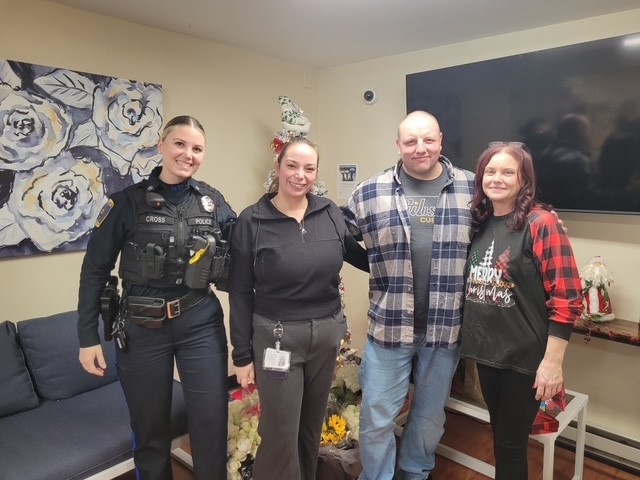
Pictured: Officer Cross, Clinician Dawn, Officer McCarthy, Director Missy
The Norton Housing Authority manages two major residential properties in the Town of Norton with one hundred and forty-four housing units. The elderly and handicap development is located at 120 West Main Street and the family development is Jacob’s Way located off of Newcomb Street. The Anti-Crime Team has built a strong relationship with management to ensure safety and security in both of these communities.
With a previous memorandum of understanding (MOU) with Norton Housing and the Norton Police, the Anti-Crime Team assists Norton Housing with potential new residents. By assisting with this, it assists management with getting the best quality candidate for that community. We also continue to assist with additional security proposals, including but not limited to updating firearm policies and an updated security surveillance system.
Extended Stay Hotel
The Extended Stay hotel located at 280 South Washington St. has historically had a high call volume for police related incidents. This year the emergency shelter for migrants stopped in the late spring. The hotel continues to be a high call volume location. We work collaboratively with management to assist with resources when issues arise. The incidents include domestic violence, overdoses, thefts, drug related crime, warrant arrests, mental health and well-being checks.
274 East Main Street and Norton Glen Apartments
We continue to work with our area large scale apartment complexes to provide resources for quality-of-life related issues. The team continued our partnership with the Norton Glen Management. We continued the process of eviction for individuals who were causing disturbances within that community. There were also several other individuals who were trespassed from the property that were causing problems. We also participated in annual community events at the Norton Glen. We held an ice cream social as well as participated in a toy drive and turkey distribution during the holiday season. We have plans to continue attending these events and building strong community ties with residents.
2026 Goals
We will look to send officers to continue training with the Community Crisis Intervention Team (CCIT). CCIT is a unique Jail Diversion Program established in 2001 by the City of Taunton Massachusetts Police Department and other concerned community participants. CCIT is not a traditional jail diversion program, where training for law enforcement focuses on pre-arrest diversion. Instead, CCIT incorporates a community response that also diverts people with disabilities at a number of junctures.
Looking to the future, the Problem Oriented Policing Team would like to move an officer out of patrol to do full time Co-Responder duties in plain clothes using grant or other funding. We will continue to provide outreach to those community members suffering from addiction and mental health as well as to continue to provide services for their families. We wish to continue to receive grant funding and increase the hours of our clinician. This has been a well-received, helpful and needed addition to the department and the community. This resource provides direct contract for individuals suffering from mental health for twenty-four-hour services in the Town of Norton.